Response to input on UPLG
Province of Utrecht published Utrecht Programme for the Countryside (UPLG) and responds to input
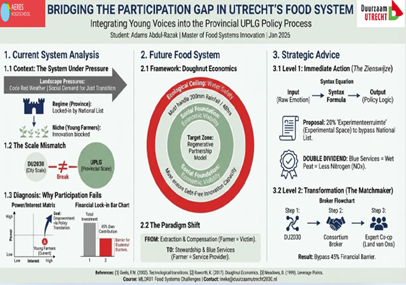
End of 2025, the province of Utrecht sollicited input in its draft programme for the countryside (UPLG). Intern Abdul-Razak Adams organised a policy sprint for Duurzaam Utrecht 2030 on 8 January 2026, collecting responses from 10 participants on a shared 'Zienswijze'. The province adopted its final UPLG and published the responses to the inputs. Here is the machine translation into English of the responses to out Zienswijzen:
Page 529
1325 0185 Citizens initiative DU2030
According to the submitter, the UPLG reserves large parts of the countryside for water retention. Currently, this is framed as a 'calamity', where farmers may incidentally qualify for compensation of disadvantages. This frame creates major uncertainty and psychological resistance. Proposer requires shifting the narrative from compensation to Payment of Ecosystem Services (or Green-Blue services).
Response: For an area to be designated as a storage area, it must be included in the water board’s register, and the area must also be assigned a function for water management purposes in the environmental plan. Should there be disproportionately adverse effects on a stakeholder, it is up to the water board to consider possible compensation. In addition, the UPLG specifies a requirement for capturing rainwater from peak downpours at ground level in polder areas. We expect this to require approximately 10–15% of the space in polders and are initially focusing on the lowest-lying areas where this rainwater naturally flows. These areas are shown on Map 4 so that they can be taken into account in spatial development and land-use planning.
Translated with DeepL.com (free version)
1326 0185 Citizens initiative DU2030
According to the submitter, there is concern that once the UPLG is adopted, the “drawing board” will be closed to local knowledge. In response, the submitter has two proposals: Proposal a) Do not rely solely on central modeling, but also establish Local Expert Teams to validate water management measures before implementation.
Proposal b) Do not designate any area within the UPLG as a retention/emergency zone (with regard to water retention capacity) until a definitive compensation protocol has been signed with the farmers concerned. Clarity regarding the financial terms must be established in advance.
Response: Both retaining water for dry periods and storing excess water during periods of high water levels are major challenges. Finding space for water is a collaborative process that we are undertaking together with, among others, the water boards and our partners in the Central Holland Delta Region. A region-specific implementation plan will be developed—in conjunction with other challenges—through the regional processes, among other channels. For more information on the approach and the process, see the responses in Chapter 3.3.2: Space for Water. In the final UPLG, we discuss the implementation more extensively, including the use of research by design with integral teams.
Translated with DeepL.com (free version)
Read the Nota van Beantwoording in Dutch here: www.provincie-utrecht.nl/uplgnvb
En the UPLG here: www.provincie-utrecht.nl/uplg